Let me start by declaring my support for values based organisations. Companies that truly demonstrate a set of positive values that affect how people feel and therefore how they behave. These businesses can see fantastic and sustainable results.
However
The “however” is that displayed values are the outcome of a list of activities, and not something that you can posted on walls and imposed on people. Even if you have gone through a comprehensive staff consultation to determine them, you simply can’t impose them. Sorry to sound cynical, but employees are hardly likely to suggest values such as “be closed, negative, deceitful and uncooperative”.
Developing cynicism
I have witnessed many companies post this years values, and when I put myself in the shoes of the employees, I can’t imagine feeling anything else other than patronised. Poorly trained managers further reduce buy in by, for example, lifting the values into performance conversations. Asking people to “rate themselves out of 10 on their own openness and honesty”. This deserves no better response than: “Well SIR! I don’t remember being closed and dishonest (well not that I’d own up to) so it must be 10 out of 10, now where’s my bonus and pay raise?”
When values are poorly introduced people become cynical and start to parody the values. They share stories about when the exact opposite to a desired value was displayed. If enough of these stories are shared it’s the negative value that gets perceived and therefore becomes the reality.
Sometimes the wording isn’t useful. When describing values you can’t really outshine “Peace” “Love” and “Understanding”. However, you can imagine the reaction if an organisation posted these on office walls. Instead we massage them into corporate speak and people don’t recognise them and therefore don’t own them.
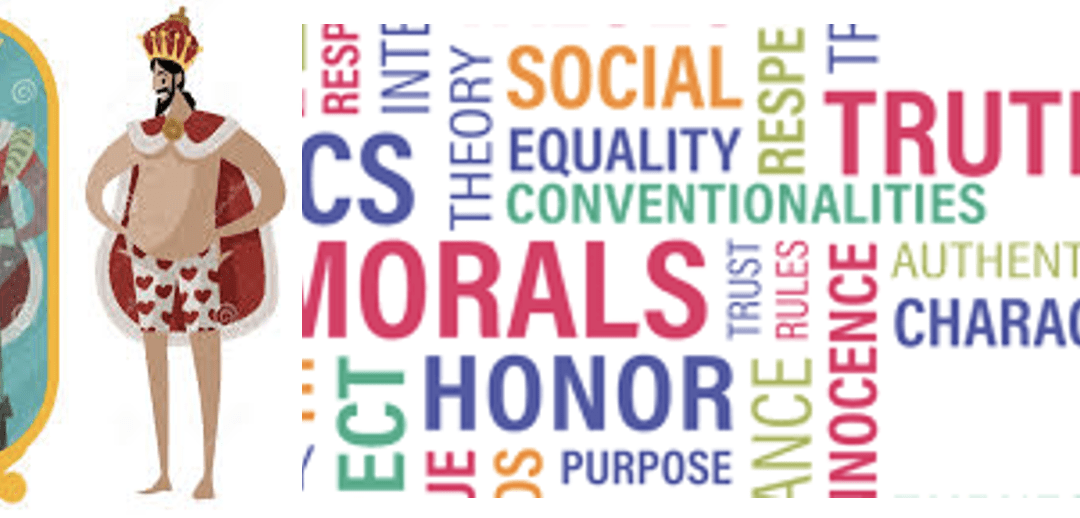
In most organisations where values are being foisted upon the masses, a large body of people will attempt to use them and develop a speak that creates an impression that the emperor really is claiming to be “wearing new clothes”.
Shifting to positive
Turning from cynical to positive, its time to pose the question: “So how do you develop a truly, values based organisation?”It’s always good to start with a vision “where do we want to be?” If organisations choose to design a set of values it is important that these are presented as aspirational – “the way we want to be”. If they are presented as a state that already exists the cynics will flock like vultures around a dead carcass.
Leadership is the answer
The second and most important factor is leadership. Children develop values and adopt behaviours according to how they are raised by their parents. Employees, the supposedly most important asset of an organisation, develop values and adopt behaviours according to how they are led. If you want a set of values to be evident in an organisation, make sure that the managers and leaders can exhibit those values par excellence.
The scout association, and most professional and amateur sports bodies, will not let people lead without giving them leadership training. A lot of commercial organisations promote people because of their technical competence and assume that they’ll work out the leadership piece as they go. Really!!
Leaders need to lead more than manage
Leaders who lead and have their training aligned to the aspired values, and leaders who spend up to or over 40% of their time leading, not managing the day to day operations, will significantly increase the chances of the desired values becoming a reality. With the subsequent uplift in quality, innovation, staff motivation and retention.
The third key element in attaining a desired set of values is the communication flow. But as most of the communication flow of a business is, or should be, through the leadership population I’d be re-making many of the points above.
Change Champions.
Designated change champions have their place. However, the values champions should be the leaders i.e. to lead by example. Appointing values champions often deflects the responsibility away from the leaders role and is often the equivalent of sending out a troupe of naked kings to convince the public that the whole wardrobe is new.
Final reality
The last thing to remember is that people have spent a lifetime developing their own values, no company is going to shift those values with an annual initiative.
Culture Dynamics design and deliver training, engagement and change programmes for leaders and business teams. Training that supports change, growth, innovation and efficiency. If you would like to find out more about our employee training please get in touch.
Author: Colin Dulson